Augmentation Research Center · SRI
The Mother of All Demos — 05 / 07
The Laboratory
It is called Engelbart's demo. It was not Engelbart's work alone.
01
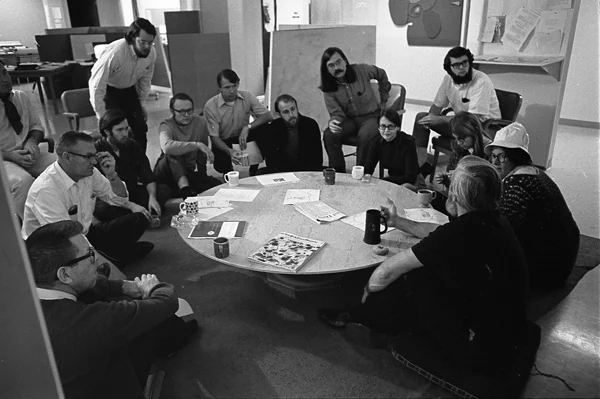
Thirty-odd people
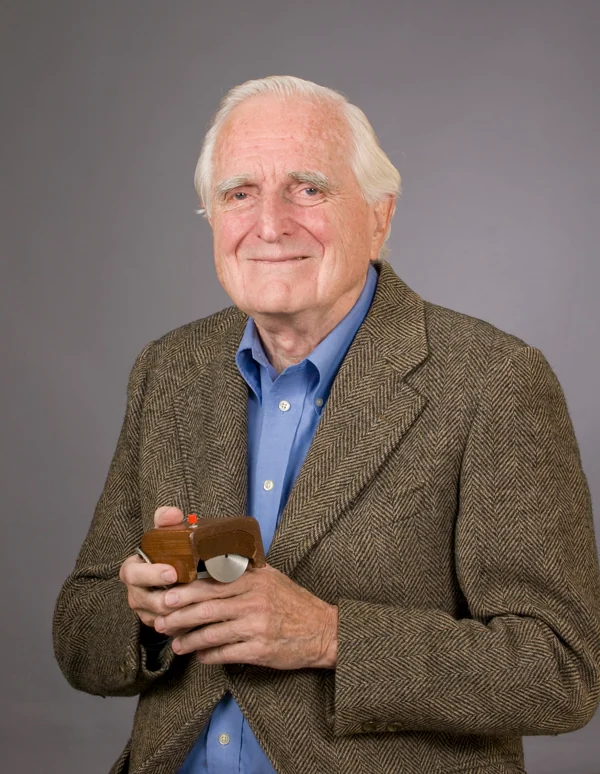
Bill English built the mouse and directed the show from the auditorium. Jeff Rulifson wrote the software. Bill Paxton was the face and the second pointer at the Menlo Park end. Don Andrews, Roger Bates, Bruce Hardy, Dave Casseres, Martin Hardy and a dozen more built, wired, cued and ran it.
The Augmentation Research Center was thirty-odd people who thought a computer's job was to make a group of humans collectively smarter. Everything on this site is a side effect of that idea.
02
Where it came from
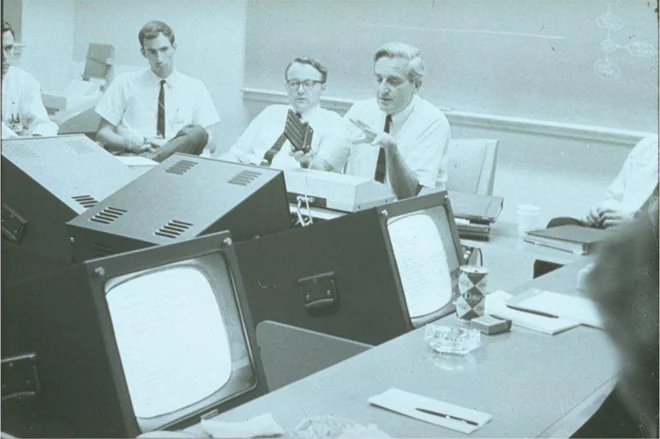
In 1945 Engelbart read Vannevar Bush's description of the memex — a desk that holds a library and remembers the trails a reader makes through it — in a Red Cross library in the Philippines.
Newly engaged and deciding his career had no goal, he spent months choosing one, and settled on making groups of people collectively better at hard problems. Augmenting Human Intellect set out the framework in 1962: not a faster clerk, but a system of tools, language, method and training.
Read the 1962 framework
Augmenting Human Intellect is still the clearest statement of what the demonstration was for.