01 / 07
The Mother of All Demos
SRI · San Francisco · 9 December 1968
The Demo
Ninety minutes in which a thousand computer professionals saw the mouse, hypertext, windows and shared editing arrive as one working system.
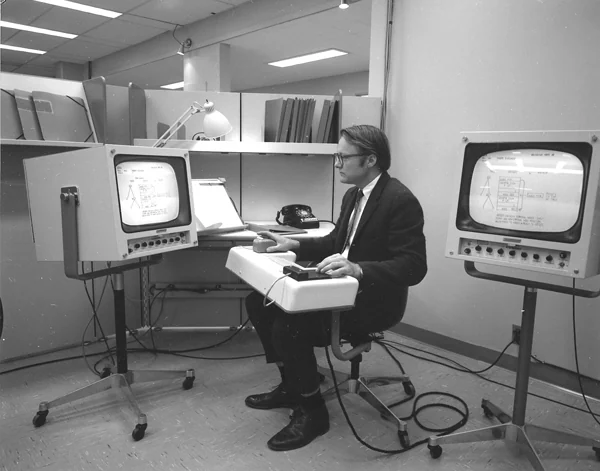
An NLS workstation at SRI in 1968 — mouse at the right hand, keyset at the left. Photograph: SRI International, CC BY-SA 3.0.
01
The room
One man, one console, no second take
The Fall Joint Computer Conference filled the Civic Auditorium. Engelbart sat alone on stage in a headset, his display projected twenty-two feet above him. The computer answering him was in Menlo Park, thirty miles away.
Two microwave links carried the picture down the peninsula and back; a leased line carried the keystrokes; a borrowed projector put it on the wall. Seventeen people ran cameras, mixers and cues at both ends. It was live, continuous and unrehearsed.
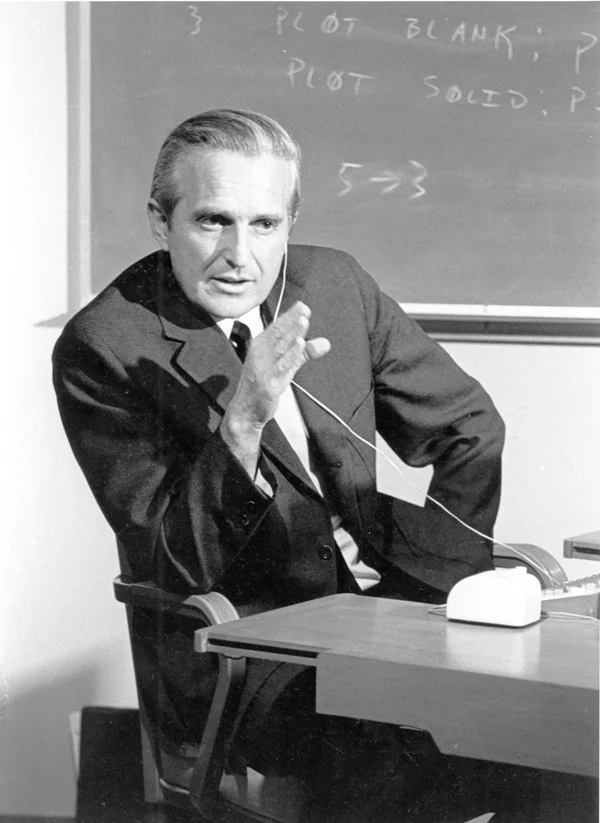
Douglas Engelbart at SRI, 1968. Photograph: SRI International, CC BY-SA 3.0.
02
The vocabulary
Six ideas, demonstrated together
The achievement was not any one of them, but that they arrived as one system, each making the others worth having.
- Pointing — a cursor tracking a hand across a desk.
- Linking — any word carrying an address to another document.
- Windows — the screen divided into independent, resizable views.
- Structure — every line belonging to a hierarchy you could operate.
- Shared editing — two people in one file, each with a visible pointer.
- Presence — a face and a voice sharing the screen with the document.
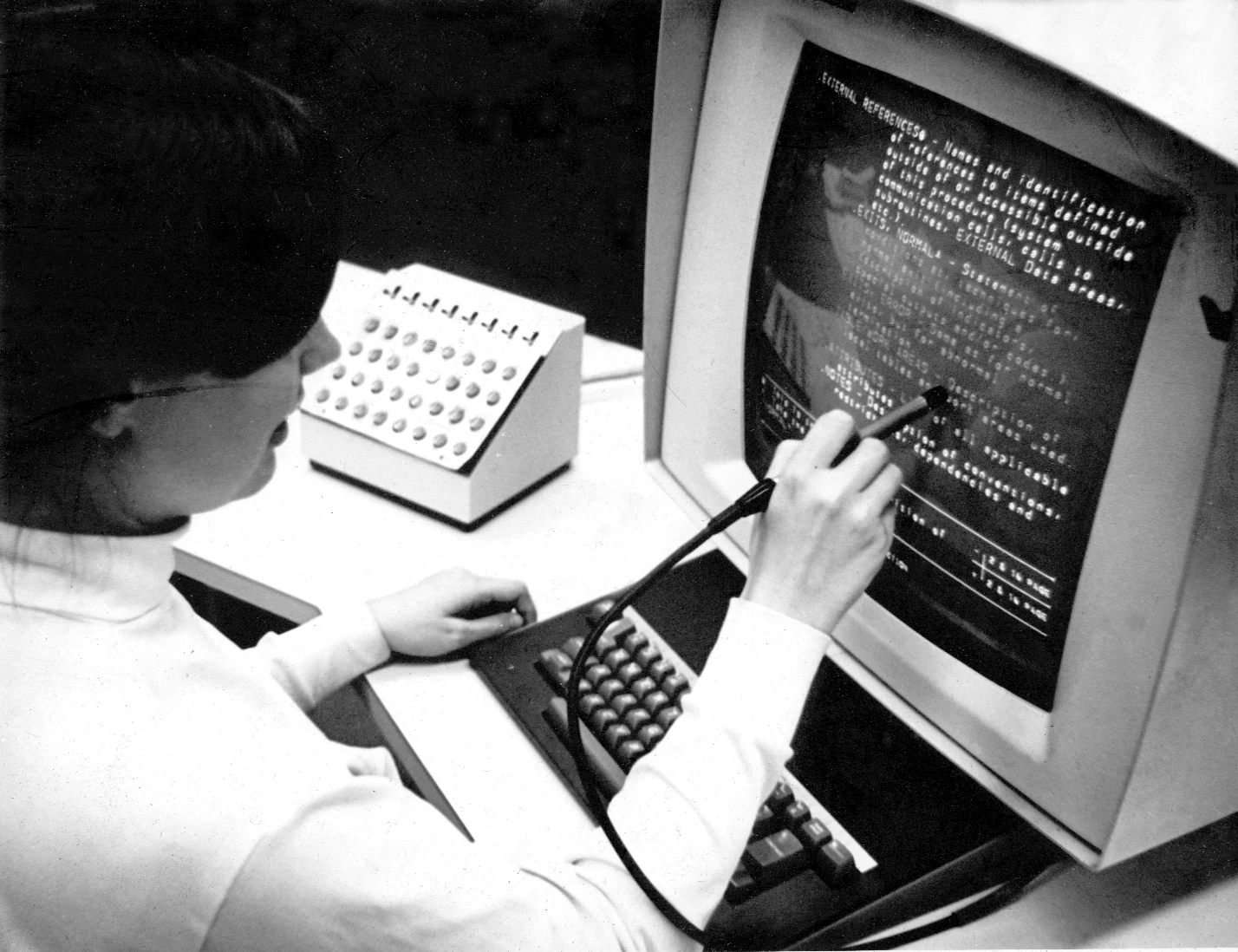
The same console, with its bank of function buttons. Brown University, 1969. Photograph: Gregory Lloyd, CC BY 2.0.
03
The screen
What a screen was in 1968
A computer display was a laboratory instrument: glowing vector strokes on a phosphor tube, priced in thousands. Most people who used a computer never saw one — they handed in a deck of cards and collected paper hours later.
Engelbart's argument was that a screen is not an output device. It is where thinking happens, and the pointing, the linking and the structure all follow from taking that seriously.
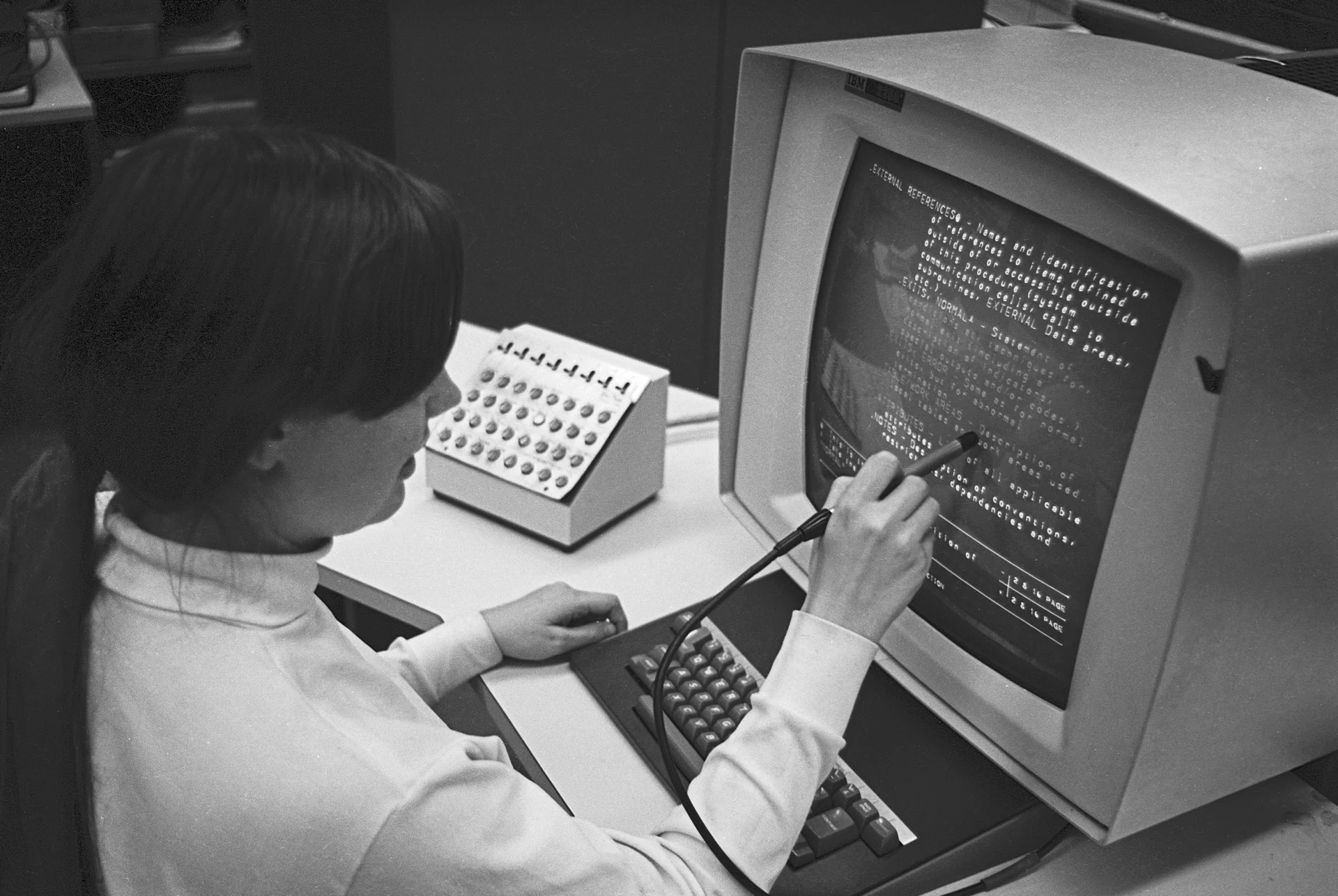
Not the 1968 demonstration: the Hypertext Editing System at Brown University, October 1969, a light pen selecting one line of linked text. Photograph: Gregory Lloyd, CC BY-SA 4.0.
The recording still exists
All ninety minutes were filmed, and the film survives — slower than a modern launch, and stranger than most science fiction.
The future
was shared.